Current Construction Notice(s) / Aviso(s) de Obra en Curso
Marina Coast Water District is adding valves to existing fire hydrants, replacing mainline valves, and replacing some existing hydrants within Marina and Seaside. This is a routine infrastructure improvement to support fire safety and reliable water system operations.
Construction Began
April 28, 2026
Expected Completion
Late July 2026
Work Hours
Mon–Fri, 8:00 AM–4:00 PM
About This Project
Marina Coast Water District is replacing fire hydrants and associated valves at multiple locations within the cities of Marina and Seaside. More information and maps of the locations are found below.
Purpose & Benefits
Fire hydrants provide reliable access to the potable water system for first responders to extinguish fires, saving lives and property. They are also used for other regulated purposes, including flushing water mains and conducting maintenance. This project is part of MCWD's ongoing asset management program to ensure long-term system reliability and efficiency.
Construction Timeline
April 28, 2026 — Construction began
April–July 2026 — Valve and hydrant replacement. Flaggers on site to manage traffic.
Late July 2026 — Expected completion. All work zones restored.
Work Hours
Working hours are Monday–Friday from 8:00 AM – 4:00 PM.
What to Expect During Construction
No Traffic Impacts. Flaggers will be on site to safely direct traffic through active work zones. Traffic impacts will vary by location and construction phase.
Access to Homes and Intersections. Brief, localized disruptions to street access may occur during active excavation. Advance notice will be provided when access may be affected.
Noise and Dust Control. Construction activity will create temporary noise and dust. Crews will follow City of Marina and City of Seaside requirements for dust control and permitted work hours.
Safety
- All work zones will be secured at the end of each workday for your safety.
- We ask that you use caution when traveling adjacent to active work sites for the safety of both our employees and the general public.
Photos & Maps
The following are in PDF format and will open in a new tab or window.
Questions & Updates
We are committed to keeping the community informed throughout this project. We'll share updates as the project moves forward. If you have questions or would like to receive updates directly, please reach out.
Stay Updated
Stay informed — We'll share updates as the project moves forward.
Construction Begins
Mid-April 2026
Expected Completion of Documents
Late June 2026
Stay informed — We'll share updates as the project moves forward. Go to the Updates
About This Project
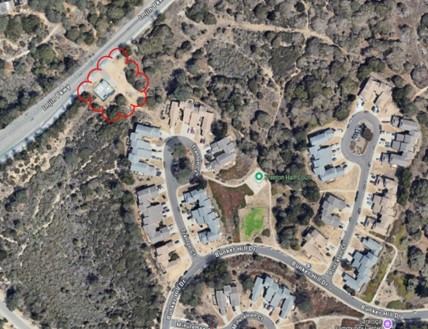
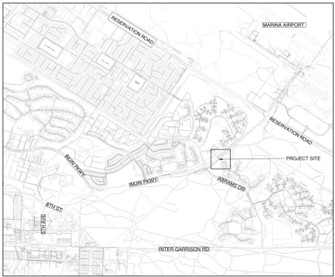
Marina Coast Water District is performing upgrades to the Imjin Sewer Lift Station, located on Imjin Parkway, approximately 650 feet northeast of the Imjin Parkway/Abrams Drive roundabout.
What is a Sewer Lift Station? A lift station pumps wastewater uphill through the sewer system.
Purpose and Benefits of the Project. This project is part of ongoing odor control efforts that reduce corrosive environments that deteriorate sewer infrastructure and cause odor.
Construction Timeline
Mid-April 2026 — Construction begins
Late June 2026 — Expected completion
Work Hours
Working hours are Monday–Friday, 7 AM to 5 PM.
What to Expect During Construction
No Traffic Impacts. All work will be outside of the roadway
No Impacts to Access to Homes and Intersections. This work will not impact access to homes, businesses or intersections.
Noise and Dust Control. Construction activity will create temporary noise and dust. Crews will follow City of Marina requirements for dust control and permitted work hours.
Safety
All work zones will be secured at the end of each workday for your safety.
While all improvements are limited to areas outside the roadway, we ask that you use caution when traveling adjacent to the site for the safety of both our employees and the general public.
Photos & Maps
Questions & Updates
We are committed to keeping the community informed throughout this project. We'll share updates as the project moves forward. If you have questions or would like to receive updates directly, please reach out.
Stay Updated
Stay informed — We'll share updates as the project moves forward.
Beach Work Begins
March 2026
Beach Work Ends
Mid-May 2026
Full Project Complete
Q1 2027
New Water Supply
300 AF/year
Stay informed — We'll share updates as the project moves forward. Go to the Updates.
About This Project
Marina Coast Water District (MCWD) is rehabilitating its existing desalination system on Reservation Road — infrastructure that was originally constructed in 1996 and last operated in 2003.
Why the desalination plant is being rehabilitated now
MCWD has a reliable, diversified water supply today and a long-range plan to responsibly add new sources over time as the community grows. Good engineering practice avoids overbuilding so the District brings capacity online in planned steps, when and as it is needed. This rehabilitation is one of those steps, adding 300 acre-feet per year of locally produced water. It has been identified in MCWD's Urban Water Management Plan and has been part of the District's Regional Urban Water Augmentation Project since 2008 and is approved under CEQA.
This project:
- Diversifies the water supply portfolio and improves long-term supply reliability.
- Supports groundwater basin sustainability by reducing dependence on local groundwater basins.
- Gives MCWD the supply flexibility to help support low-income housing growth required of local cities and the County.
What you see on the beach
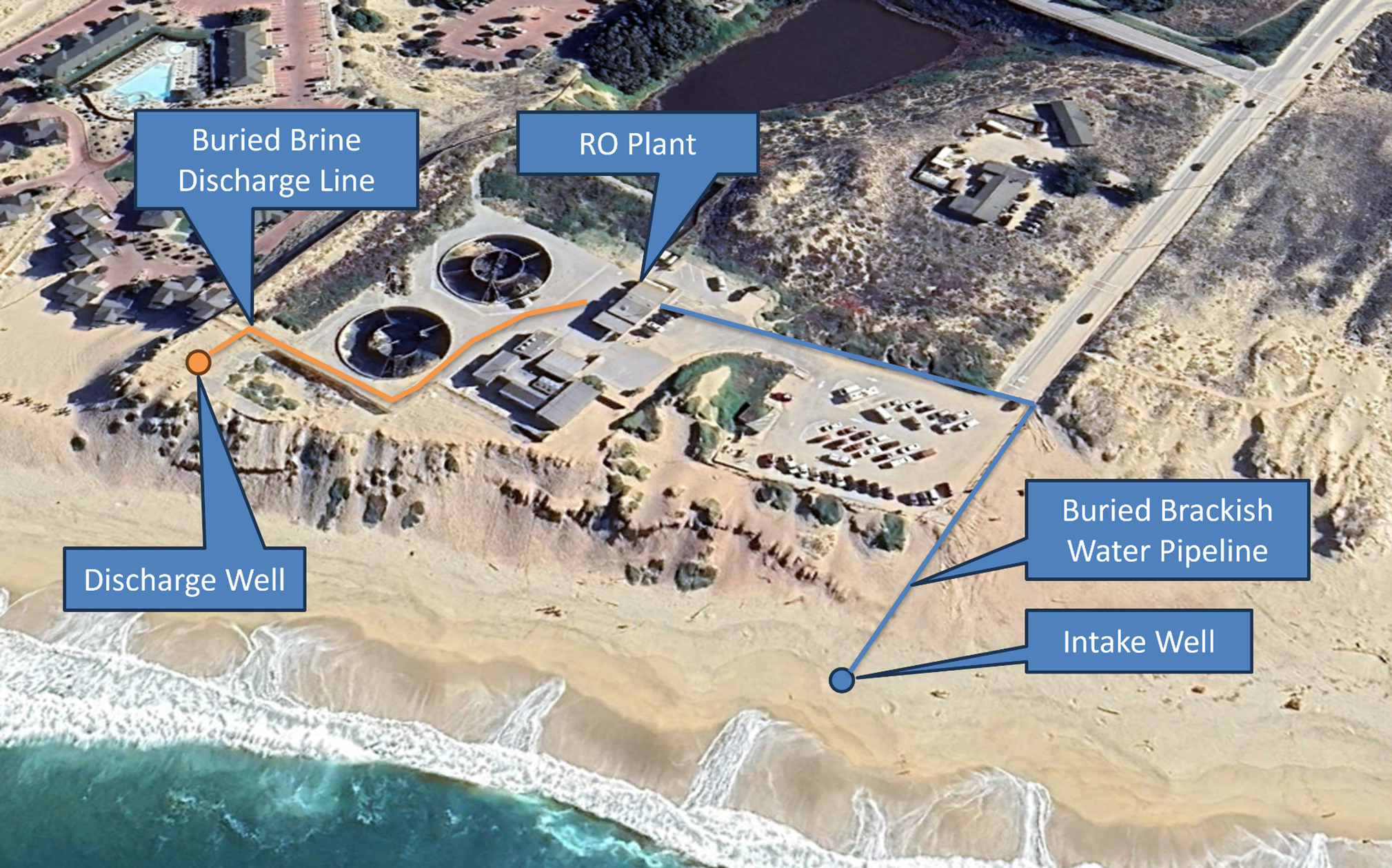
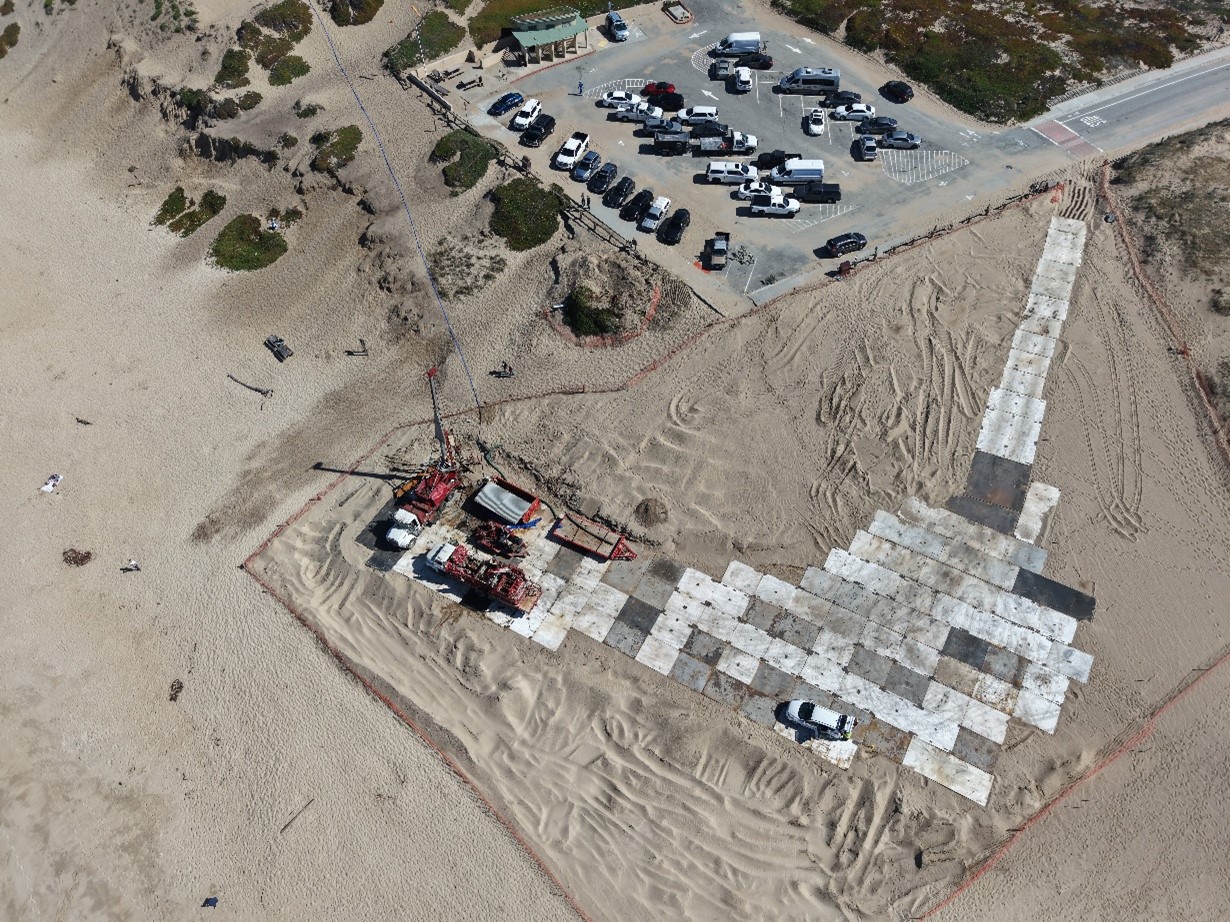
Work on the beach involves cleaning and rehabilitating the existing intake well, re- installing a vault and wellhead, and replacing an old pipeline from the beach well under the parking lot to the treatment plant. The pipeline work will require trenching on the beach to replace the old pipeline. Steel construction plates are temporarily placed on the beach to protect the beach and prevent equipment from becoming stuck. The plates are planned to be removed by the week of March 30. A protected walkway will be maintained throughout construction to preserve public beach access and protect sensitive areas of the dunes from both construction equipment and foot traffic.
What you will soon see on the bluffs
Work on the bluffs involves rehabilitating the brine discharge well on District property, approximately 40 feet above the beach. This work falls within MCWD's existing property line and within the footprint of existing infrastructure.
Parking lot work
In order to support our community and continued access to the beach, pipeline connections between the beach and the treatment plant will be made using horizontal directional drilling beneath the parking lot. This technique eliminates the need for open trenching and ensures that vehicle and pedestrian access to the beach remains open throughout construction.
Construction Timeline
March 2026 — Beach construction begins
Intake and discharge well rehabilitation begins. Construction plates placed on beach. Protected pedestrian walkway established. Biologists are monitoring the Snowy Plover until work is completely cleared off the beach, around mid-May.
Mid-April 2026 — Decrease footprint on the beach
Steel plates in the beach work area are removed by about mid-April. The work footprint is significantly reduced but work continues on the beach as the well head vault construction begins.
Mid-May 2026 — Intake Well rehabilitation complete
New vault and wellhead are installed. Beach well work finishes by about mid-May and the Beach is returned to its previous grade as required by the permit with State Parks.
March 2026 through May 2026 — Bluff and parking lot work
Brine discharge well rehabilitation at the District's Reservation Rd facility. Parking lot directional drilling. Desal Plant facility work.
May 2026 — Phase I Complete
Intake well rehabilitation complete and water quality testing will begin as Phase II design is underway.
September - December 2026 — Phase II construction begins
Work on the Reverse Osmosis (RO) building.
First Quarter of 2027 — Full rehabilitation complete
The desalination system is online and delivering 300 acre-feet of new water per year.
Environmental Protections
MCWD takes its stewardship of the beach environment seriously. Multiple layers of regulatory oversight and proactive monitoring are in place throughout this project.
Snowy Plover monitoring
A professional wildlife biologist is on-site conducting daily monitoring for the Western Snowy Plover, a threatened shorebird that nests in this area. MCWD is working with Point Blue Conservation Science who partnered with the U.S. Fish and Wildlife Service for over two decades on monitoring and protecting the Snowy Plovers along the Monterey Bay and is considered the leading expert in the region. State Parks has reviewed and approved the monitoring program. Biologists are monitoring the Snowy Plover until work is completely cleared off the beach, around April 30.
Monterey Spineflower
The pipeline and infrastructure route has been specifically relocated away from any potential habitat for the Monterey Spineflower, an endangered plant species. MCWD is also working to comply with the intent of the City of Marina's draft Coastal Land Use Plan biological resource policies, including working with a qualified biologist to identify Environmentally Sensitive Habitat.
Permits and regulatory compliance
All necessary permits were in place prior to construction starting. A Notice of Exemption under CEQA was filed with the state on September 25, 2025, as this is the rehabilitation of an existing facility. MCWD holds a Right of Entry permit from California State Parks that sets requirements for the work and requires restoration of all affected areas to their natural condition. The existing Coastal Development Permit is current and the rehabilitation work complies with all its terms.
Sea level rise and managed retreat
MCWD has accounted for sea level rise and ongoing wave erosion in the project design. This project is part of the District's managed retreat strategy for facilities located west of Highway 1.
Frequently Asked Questions
Why is there heavy equipment and steel plates on the beach?
The steel plates protect the sand from equipment and prevent construction machinery from becoming stuck in soft beach sand. They are temporary measures required only during active well rehabilitation work on the beach and will be removed once that phase is complete — anticipated by the end of March.
Can I still access the beach during construction?
Yes. MCWD is required to maintain public beach access throughout construction. A protected, dedicated pedestrian walkway is in place for the duration of beach-side work. The parking lot will also remain 100% accessible, as pipeline work there uses underground drilling rather than open trenches.
Is this a new desalination plant, or something else?
This is a rehabilitation of an existing facility — not new construction. The desalination system was built in 1996 and operated successfully until 2003. MCWD is cleaning, repairing, and upgrading existing wells and infrastructure to bring the system back into service. No new wells are being drilled.
Was this project properly reviewed under environmental law?
Yes. A Notice of Exemption (NOE) under the California Environmental Quality Act (CEQA) was filed with the state on September 25, 2025. Because this is the rehabilitation of an existing facility — not new construction — the project qualifies for this exemption. The filing is publicly available at the CEQA Net database. All required permits from State Parks and other agencies are in place.
What protections are in place for wildlife, especially the Snowy Plover?
Daily on-site monitoring for the Western Snowy Plover is being conducted by Point Blue Conservation Science who partnered with the U.S. Fish and Wildlife Service for over two decades on monitoring and protecting the Snowy Plovers in the Monterey Bay and is considered the leading expert in the region. California State Parks has reviewed and approved the monitoring approach. The Monterey Spineflower's potential habitat has also been avoided by carefully routing all pipeline infrastructure. Biologists are monitoring the Snowy Plover until work is completely cleared off the beach, around April 30.
Will this change what the beach looks like?
No. All beach areas disturbed by construction will be restored to their natural condition, as required by MCWD's Right of Entry permit with State Parks. The existing beach well will remain below ground, and the bluff-side equipment will remain in the existing area and largely out of sight from the beach.
Why is MCWD adding desalination capacity now?
MCWD has a reliable water supply today and a long-range plan — the Urban Water Management Plan, last updated in 2020 — to add new sources in a stepwise manner as the community grows and needs increase. Good engineering practice means not overbuilding: the District brings capacity online when and as it is needed. This rehabilitation adds 300 acre-feet per year of locally produced water, further diversifying the communities' water portfolio. The project is identified in MCWD's current Regional Urban Water Augmentation Project which was approved under CEQA in 2008.
How long will the disruption on the beach last?
The most visible beach construction — including the steel plates — is expected to be fully complete by approximately April 17, 2026. Work will continue on the bluffs and in the parking lot through 2026, but this will be less visually impactful. The full project, including treatment facility work, will be complete and operational by the first quarter of 2027.
Who approved this project and what permits does MCWD hold?
MCWD holds a valid Coastal Development Permit, a Right of Entry permit from California State Parks, and has completed CEQA review via Notice of Exemption. State Parks has reviewed and approved the Snowy Plover monitoring plan. The desal project has been identified in MCWD's Urban Water Management Plan and approved through the Former Fort Ord Reuse Authority (FORA) supply planning process dating back to 2008.
Water Supply: Adequate Today, Planning for Tomorrow
MCWD provides customers with high-quality, reliable water today. The District's approach to water supply is based on sound planning. It builds on a diversified portfolio and adding new sources in deliberate, cost-efficient steps over time as community needs grow.
The Regional Urban Water Augmentation Project (RUWAP)
In 2008, MCWD developed RUWAP — a long-range plan to provide a sustainable, diversified water supply for the Fort Ord redevelopment area and the broader community. The plan identifies a portfolio of sources to be brought online in sequence, when needed:
- Pure Water Monterey — Phase I — (600 acre-feet per year [AFY]) In service since 2022
- Pure Water Monterey — Phase II — (827 AFY) In service since 2025
- Reservation Road Desalination Rehabilitation — (300 AFY) To be online by about April 2027
- Indirect Potable Reuse Project — (1,120 AFY) Actively in planning the next major step
- Garrison Ocean Desalination — (1,500 AFY) Planned for future phases
Smart, stepwise growth — not overbuilding
MCWD's approach reflects good engineering practice: sizing projects to meet actual near-term needs, then build the next increment when the time is right. This avoids unnecessary cost to ratepayers and ensures each project is operationally justified. The Urban Water Management Plan — most recently updated in 2020 — identifies when each new supply source will be needed based on projected demand through 2040 and beyond.
Refitting an existing plant is faster, lower cost, and lower risk
The Reservation Road plant was constructed in 1996 and successfully operated through 2003 before being placed on standby. Rehabilitating existing infrastructure is significantly faster, less expensive, and less disruptive than building new facilities. Technology has also improved substantially since 1996, so the District expects better performance and efficiency from the refitted system.
Supporting the broader community and a sustainable environment
MCWD's water supply planning serves more than its direct customers. As the designated Groundwater Sustainability Agency (GSA), MCWD is responsible for the long-term health of the local groundwater supply. As a County Water Agency, we support water suppliers and communities across Monterey County by providing interagency support through mutual aid agreements, interties, and water wheeling agreements. Our many initiatives even include projects like our project with the Central Coast Wetlands Group to protect Groundwater Dependent Ecosystems and promote sustainable management.
Documents
Notice of Exemption (NOE) under the California Environmental Quality Act (CEQA)
Photos
Questions & Updates
We are committed to keeping the community informed throughout this project. We'll share updates as the project moves forward. If you have questions or would like to receive updates directly, please reach out.
Recent Q/A about the Reservation Road Desal Rehabilitation Project
Below are answers to questions we have received from customers about the Reservation Road Desal Project.
Q: Is the desal facility, in its revamped form, to be solar powered?
The desalination facility itself is not powered directly by solar energy. However, MCWD is expanding renewable and backup power systems across its facilities to reduce emissions, improve reliability, and reduce costs. This includes solar and battery systems at our main office, as well as backup power systems to ensure water service can continue during outages.
MCWD has already reduced greenhouse gas emissions by 230 metric tons of carbon dioxide (over 50% reduction) by transitioning to 100% renewable electricity and continues investing in solar, battery storage, and clean energy solutions systemwide.
Click here to show/hide additional questions
Q: When was the original desalination plant built in Marina, and why did it stop?
The Reservation Road desalination plant was constructed in 1996 and began operating in 1997. It operated until 2003 when the facility was placed on standby rather than decommissioned.
Since then, desalination technology has become significantly more energy efficient. Combined with current long-term water supply needs, it is now cost-effective and appropriate to bring the facility back into service.
Q: Why isn't MCWD part of Sites Reservoir?
Sites Reservoir is a proposed off-stream reservoir in Colusa County in the Sacramento Valley — more than 200 miles from Marina. While it is a significant state water project, connecting to it would require MCWD to participate in the State Water Project or a similar conveyance system, build or contract for hundreds of miles of pipeline capacity, and pay substantial capital and ongoing water delivery costs. MCWD's current approach is to develop local and regional supplies, such as desalination rehabilitation, recycled water, and groundwater management, that are closer to home, lower-cost, and more reliable for our customers.
Q: Is water going to cost more because of the desal plant?
No rate increase is expected beyond what is already planned. This rehabilitation is incorporated into MCWD's current rate structure, and rates through June 2029 that have been reviewed and approved with this work, and about $10 million per year in system improvements in mind.
The District is also actively pursuing grant funding to offset project costs for ratepayers. We are currently evaluating two to three funding opportunities that could provide between $5 million and $10 million in external support for this project. Another source of funding is development capacity fees, which are paid by developers and do not affect customer rates.
Stay Updated
Stay informed — We'll share updates as the project moves forward.
Work Begins
May 4, 2026
Work Completes
Late June 2026
California Avenue will be closed to traffic from 8:00 AM to 4:30 PM Monday through Friday. Use a Detour.
Marina Coast Water District is upgrading the water main along California Avenue between Patton Parkway and Reindollar Avenue.
We understand construction can be disruptive, and we want to share what to expect and how to stay informed.
Thank you for your patience and cooperation as we work to improve the reliability of our community's water system. We are committed to completing this project as safely and efficiently as possible.
Project Overview
Construction on the California Avenue Water Main Upsizing and Replacement Project is in the City of Marina, between Patton Parkway and Reindollar Avenue.
This project involves installing approximately 1,330 linear feet of new 12-inch water pipeline along California Avenue.
Why This Project Is Important
This improvement will:
- Increase water delivery capacity
- Improve system reliability
- Support long-term service to Central Marina
- Help ensure dependable water service for years to come
When Will Work Occur
Start Date: May 4, 2026
End Date: Late June
Work Days: Monday through Friday
Work Hours: 8:00 AM to 4:30 PM
What to Expect During Construction
Traffic Impacts
California Avenue will be closed to traffic from 8:00 AM to 4:30 PM Monday through Friday.
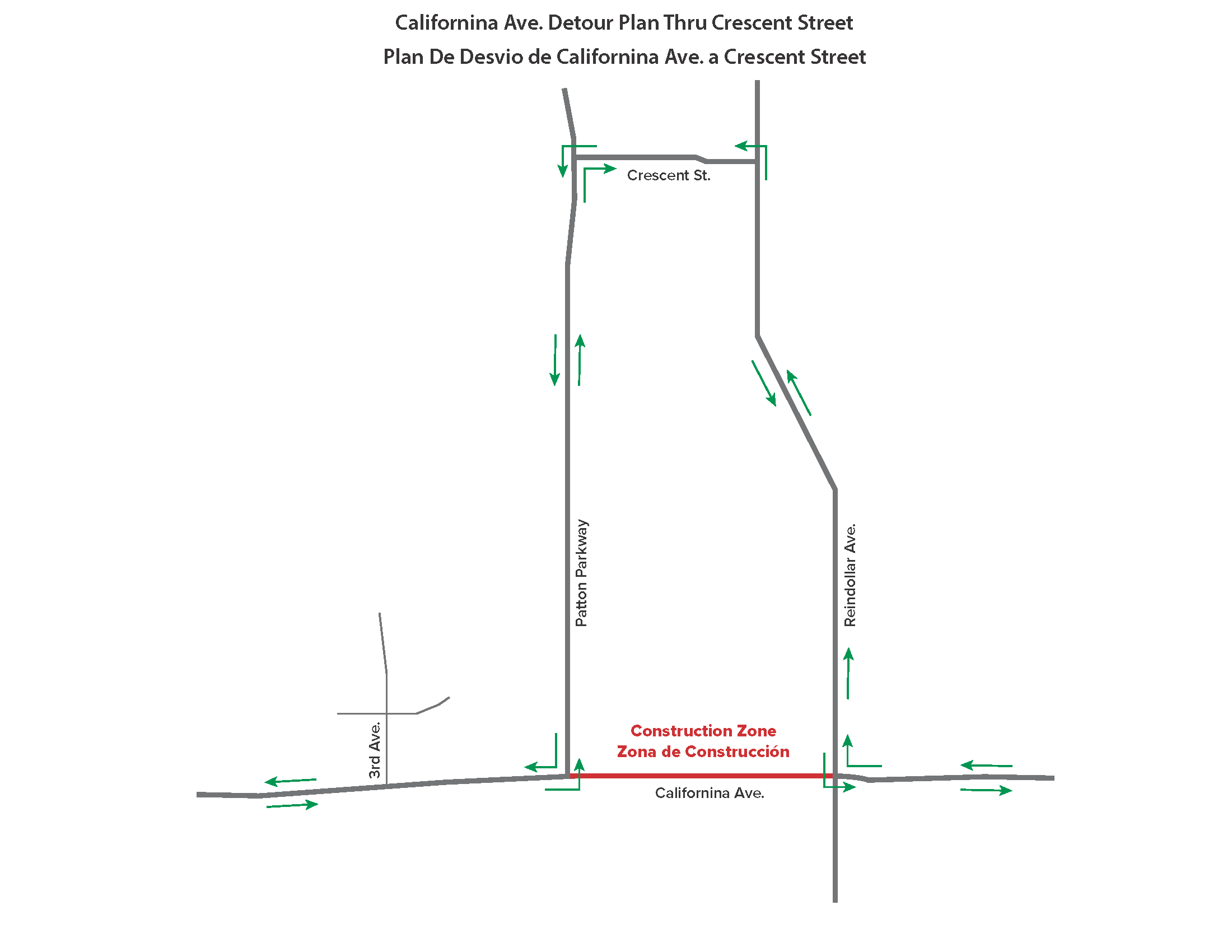
Detour on Reindollar Ave, Cresent Street, and Patton Parkway.
All traffic control will be coordinated with the City of Marina and developed in accordance with approved traffic control plans.
Traffic impacts will vary depending on the construction phase.
- Drivers are encouraged to use alternate routes when feasible
- Traffic will be directed safely through the work zone
- Motorists should expect major delays during some active work hours
- Travel times may increase during peak periods
Access to Homes and Intersections
Homes along this stretch of California Avenue are back-facing, so driveway impacts are expected to be minimal.
Noise and Dust Control
Construction activity will create temporary noise and dust. Crews will follow City of Marina requirements for dust control and permitted work hours. Dust suppression measures:
- Compliance with permitted construction hours
- Adherence to City construction standards and mitigation requirements
Safety Reminder
For the safety of the community and construction crews:
- Reduce speed in work zones
- Follow posted signage
- Obey traffic control personnel and flaggers
Maps
A map of the detour plan is shown below. View or download the map as a PDF (opens in a new browser tab).
Questions & Updates
We are committed to keeping the community informed throughout this project. We'll share updates as the project moves forward. If you have questions or would like to receive updates directly, please reach out.
Stay Updated
Stay informed — We'll share updates as the project moves forward.
Antes de que comience la construcción, el Distrito de Agua de Marina Coast (Marina Coast Water District) y la Ciudad de Marina están tomando medidas adicionales para minimizar los impactos en el tráfico y el ruido. Publicaremos un calendario de construcción actualizado una vez que esos planes estén finalizados. Gracias por su continua paciencia.
El Distrito de Agua de Marina Coast pronto comenzará a mejorar y reemplezar la tubería principal de agua a lo largo de California Avenue entre Patton Parkway y Reindollar Avenue.
Entendemos que la construcción podría ser molesta y queremos compartir lo que puede esperar y cómo mantenerse informado.
Le agradecemos su paciencia y cooperación mientras trabajamos para mejorar la fiabilidad del sistema de agua de nuestra comunidad. Nuestro compromiso es completar este proyecto con la mayor seguridad y eficiencia posible.
Contactos del Proyecto
Si tiene preguntas, inquietudes o necesita asistencia, sírvase comunicarse con:
Jack Gao
C: (831) 384-6131 or (831) 883-5900
Correo electrónico: engineering@mcwd.org
Descripción general del proyecto
El Distrito de Agua (MCWD) comenzará la construcción del Proyecto de Ampliación y Reemplazo de la Tubería Principal de Agua en California Avenue, entre Patton Parkway y Reindollar Avenue, en la ciudad de Marina.
Este proyecto implica la instalación de aproximadamente 1,330 pies lineales de nueva tubería de agua a lo largo de California Avenue.
Por qué es importante este proyecto
Esta mejora podrá:
- Aumentar la capacidad del suministro de agua
- Mejorar la fiabilidad del sistema
- Apoyar el servicio a largo plazo en Central Marina
- Ayudar a garantizar un servicio de agua seguro durante muchos años
Este proyecto forma parte del compromiso más amplio del Distrito de invertir aproximadamente 10 millones de dólares cada año en el mantenimiento y actualización de los sistemas de agua, alcantarillado y agua reciclada en toda la comunidad. Estas mejoras ayudan a garantizar la fiabilidad y calidad de su servicio.
Cu ándo se realizaría la obra
Fecha de inicio: Se anunciará un calendario de construcción y se actualizara esta página una vez que se confirmen las fechas.
Fecha de finalización: Por anunciar
Días de trabajo de la obra: de lunes a viernes
Horario de trabajo: Por anunciar
Se colocarán señales viales de preaviso antes de comenzar la obra.
Qué esperar durante la construcción
Impactos viales
Todo el control de tráfico se coordinará con la Ciudad de Marina y se desarrollará de acuerdo con los planes de control de tráfico aprobados.
El impacto vial variará según la fase del proyecto de construcción.
- Se recomienda a los conductores utilizar rutas alternas alternativas sea posible
- El tránsito será dirigido de forma manera segura a través de o alrededor de la zona de obras
- Los conductores deben anticipar demoras significativas durante algunas horas de trabajo activo
- Los tiempos de desplazamiento pueden aumentar durante las horas punta
Acceso a viviendas e intersecciones
- Ruta alternativa por Reindollar Ave, Crescent Street y Patton Parkway.
Las casas a lo largo de este tramo de California Avenue están orientadas de espaldas a la calle por lo que se espera que el impacto a las entradas de acceso de vehículos sea mínimo.
Sin embargo, durante las interconexiones de tuberías en Patton Parkway y Reindollar Avenue, pudria haber restricciones breves y temporales en las intersecciones. Si eso ocurriera, se dará aviso previo y se establecerá el control vial.
Control de ruido y polvo
La actividad de construcción generará niveles de ruido y polvo temporales. Las cuadrillas de trabajo cumplirán con los requisitos de la ciudad de Marina para el control del polvo y el horario de trabajo permitido. Medidas de supresión del polvo:
- Cumplimiento de las horas de construcción permitidas
- Cumplimiento de las normas de construcción de la Ciudad y los requisitos de mitigación
Recordatorio de seguridad
Por la seguridad de la comunidad y las cuadrillas de obreros de construcción:
- Reduzca la velocidad en zonas de obras de construcción
- Respete la señalización
- Obedezca al personal de control vial y a los banderilleros
Mapas
A continuación se muestra un mapa del plan de desvío. Vea o descargue el mapa en formato PDF (se abririá en una nueva pestaña del navegador).
Previous Projects
MCWD is installing a new water pipeline to improve the reliability and redundancy of the East Garrison portion of the MCWD water system. The current pipeline will stay in place as an emergency backup to enhance system reliability.
We apologize for any inconvenience this may cause during the construction process and are working diligently to provide safe and reliable water supply and minimize impacts to local area traffic and the community.
Where
Approximately 1,500 feet of pipeline construction will take place along Inter-Garrison Road, east of the Schoonover Road intersection.
When
Work is scheduled to be completed by the middle of September 2026.
Actions to Minimize Impacts
- Construction will take place July 18 through September 5.
- Work is occurring next to the newly paved road, on the shoulder. Two minimal road cuts will be made to connect the new pipe to the existing system.
- A traffic control plan has been approved by the County of Monterey Public Works Department and will be in place to keep traffic moving safely.
- Dust, noise, and air quality controls are being used to minimize disruption.
We're Here to Help
Contact us if you have questions or concerns. Call us at (831) 384-6131 or email us at customerservice@mcwd.org
Thank you for your patience as we improve your water system!